 Dogecoin
Dogecoin mining uses Scrypt proof of work with electricity costs that shape operating margins
Updated -Dogecoin mining adds blocks through Scrypt proof of work, with economically competitive setups generally using specialized ASIC hardware. Whether a setup makes sense depends on its power draw, electricity tariff, effective hashrate, and pool payout rules. Merged mining allows compatible work to support Dogecoin alongside another Scrypt blockchain. Before buying equipment, compare the complete installation cost with expected net earnings, including cooling, downtime, and pool deductions. A pool's advertised revenue isn't the amount left after those expenses.
The short version: The electricity budget should include the ASIC's wall consumption and any separately powered ventilation or cooling equipment.
Scrypt hardware and useful hashrate
Hardware compatibility starts with the hashing algorithm, while the purchase decision also needs a realistic measure of speed and electricity consumption.
Algorithm support
An ASIC, or application-specific integrated circuit, performs a particular computation using specialized hardware. Confirm Scrypt support in the equipment specification. A machine built exclusively for another hashing algorithm won't become compatible through a pool setting. CPUs and GPUs can calculate Scrypt hashes, although commercial operations generally rely on ASICs for competitive output.
Hashrate and efficiency
Hashrate measures hashes per second; MH/s and GH/s express that rate in millions and billions. Compare machines using the same units and operating mode. Energy per hash connects speed with power consumption, so a lower figure means less electricity for the same hashing work. Total output also matters: a more efficient unit can still draw substantial power because it performs more hashes.
Merged mining and separate payout currencies
Merged mining reuses compatible Scrypt work across separate blockchains, commonly Dogecoin and Litecoin. Auxiliary proof of work (AuxPoW) includes a commitment to a candidate Dogecoin block. The proof must satisfy Dogecoin's difficulty target and validation rules. Each chain retains its own blocks and rewards, even though the hashing work can serve both.
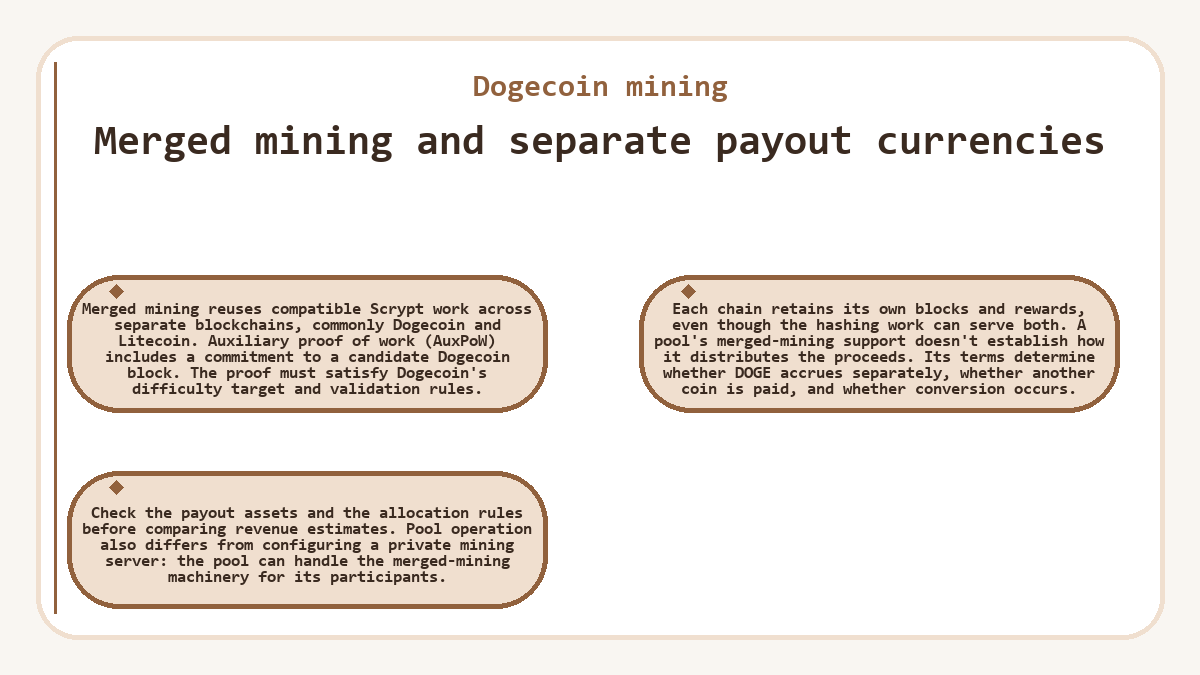
A pool's merged-mining support doesn't establish how it distributes the proceeds. Its terms determine whether DOGE accrues separately, whether another coin is paid, and whether conversion occurs. Check the payout assets and the allocation rules before comparing revenue estimates. Pool operation also differs from configuring a private mining server: the pool can handle the merged-mining machinery for its participants.
Block rewards, difficulty, and solo variance
Block production pays a subsidy to the successful block's mining recipient, alongside fees from the transactions it includes. Dogecoin's block subsidy is 10 000 DOGE. That amount belongs to the block, not to every connected machine. Pool participants receive the portion their pool's accounting rules assign to their contributed work.
Dogecoin targets one minute between blocks, although actual intervals vary. Its DigiShield mechanism adjusts mining difficulty at each block. With unchanged hashrate, a higher difficulty lowers the expected rate of qualifying proofs. A fixed subsidy therefore doesn't create a fixed daily income for a particular ASIC.
Solo mining concentrates rewards into occasional successful blocks, and a small share of network hashrate can mean a long wait. A pool spreads block production across more contributed work and distributes earnings under its chosen scheme. Neither arrangement establishes a dependable hardware-payback date.
Electrical capacity and heat removal
The installation must support the miner's continuous electrical load and remove its heat within the equipment's specified operating limits.
Power supply and circuit load
Electrical compatibility includes input voltage, the rated power supply, plugs, cabling, and the circuit's continuous-load capacity. A plug adapter doesn't increase safe circuit capacity. Have a qualified electrician assess the intended load before installation. Equipment requirements differ, so wiring suitable for another machine may be unsuitable for the unit you're considering.
Airflow and physical space
Heat must leave both the miner and the room housing it. Intake temperature, airflow clearance, fan noise, and humidity limits affect placement. Cooling equipment adds its own energy demand. Internal fans belong in the miner's wall-power measurement; room ventilation and air conditioning usually need separate accounting. A space with cheap power can still be unsuitable if it can't handle heat or noise.
Wall power and the electricity tariff
Electricity cost starts with power measured at the wall, because chip-only consumption leaves out the power supply and internal fans. Kilowatts (kW) measure power; kilowatt-hours (kWh) measure the energy consumed over time. A suitably rated meter can record actual consumption in the intended operating mode. Manufacturer figures describe specified conditions; ambient temperature and settings can change the measured draw.
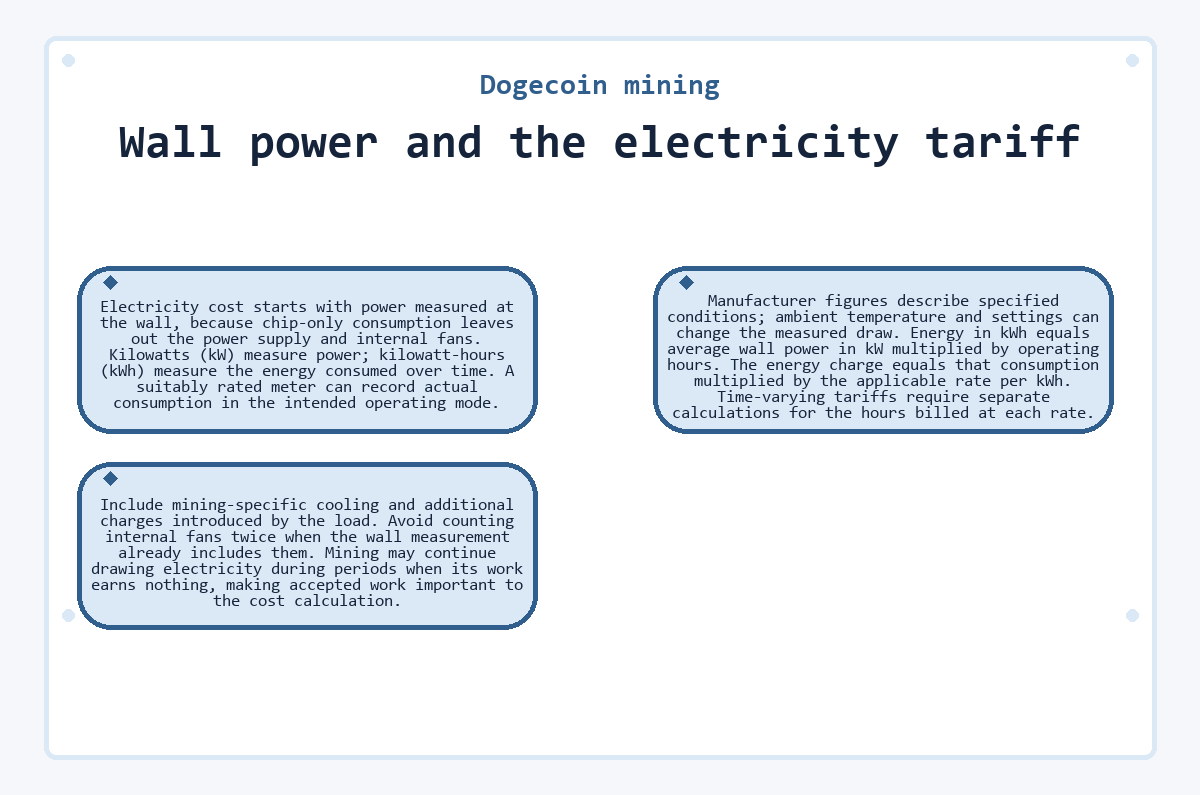
Energy in kWh equals average wall power in kW multiplied by operating hours. The energy charge equals that consumption multiplied by the applicable rate per kWh.
Time-varying tariffs require separate calculations for the hours billed at each rate. Include mining-specific cooling and additional charges introduced by the load. Avoid counting internal fans twice when the wall measurement already includes them. Mining may continue drawing electricity during periods when its work earns nothing, making accepted work important to the cost calculation.
Pool accounting and withdrawal terms
Pool selection affects reward variability and access to accrued earnings, as well as the fee deducted from mining revenue.
Pay-per-share accounting
Pay per share (PPS) credits accepted shares at the stated rate, independently of how many blocks the pool finds. A share is a proof meeting the pool's assigned work target, used to measure the miner's contribution. The operator takes on block-discovery variance, while network difficulty, coin value, and its ability to pay remain relevant.
Pay-per-last-N-shares windows
Pay per last N shares (PPLNS) allocates rewards from blocks the pool finds to eligible shares within its defined window. Earnings fluctuate with pool luck and credited work. The window's rules matter when mining is intermittent. Identical fee percentages across PPS and PPLNS don't imply identical payment patterns.
Accrued balances and payments
Withdrawal thresholds, payment schedules, payout fees, and address-change restrictions come from the pool's terms. A displayed balance hasn't necessarily reached a Dogecoin wallet. Keep accrued rewards separate from completed payments when reconciling proceeds. If an estimate already includes pool fees, subtracting the same deduction again understates the earnings.
A compatible connection and a metered run
In this hypothetical example, a Scrypt ASIC draws 1.736 kW throughout a 23.6-hour run at 0.146 currency units per kWh. Its initial connection targets an incompatible mining service. The electrical installation is suitable, and the worker credentials are otherwise valid.
The incompatible service records no accepted Scrypt shares. Changing the connection to a compatible Scrypt pool supporting Dogecoin merged mining produces accepted-share entries for the worker. Its power draw remains unchanged throughout the switch. Compatibility changes whether the work contributes to the pool, while the electricity meter continues recording consumption.
The run consumes 1.736 × 23.6 = 40.9696 kWh. Multiplying by 0.146 gives 5.9815616 currency units, approximately 5.982, for miner electricity. This calculation includes the time spent on the incompatible connection. A higher tariff would raise that bill without increasing accepted work. Separate cooling and applicable tariff extras would add further costs.
Accepted-share entries confirm the pool accepted submitted work; they don't establish that this worker found a Dogecoin block or received DOGE. For an on-chain DOGE payout, a confirmed transaction paying the intended address and the wallet's matching receipt establish delivery. Neither signal, alone, establishes a positive operating margin.
Installed cost and used equipment
The installation budget includes the miner, a separate power supply if required, delivery, and necessary electrical or ventilation work. Hosting arrangements can add contracted setup and service charges. An older unit's lower purchase price can coexist with higher energy consumption per hash. Compare the actual configuration and included parts; the age of a model alone doesn't settle its suitability.
Used equipment adds uncertainty about board condition, fan wear, and firmware. Service records, board status, and evidence of sustained Scrypt output help assess the unit you're buying. Firmware must match the exact hardware, and recovery procedures differ between models. Replacement parts, repair access, and any remaining warranty affect the cost of keeping it operational.
Operating margin and hardware payback
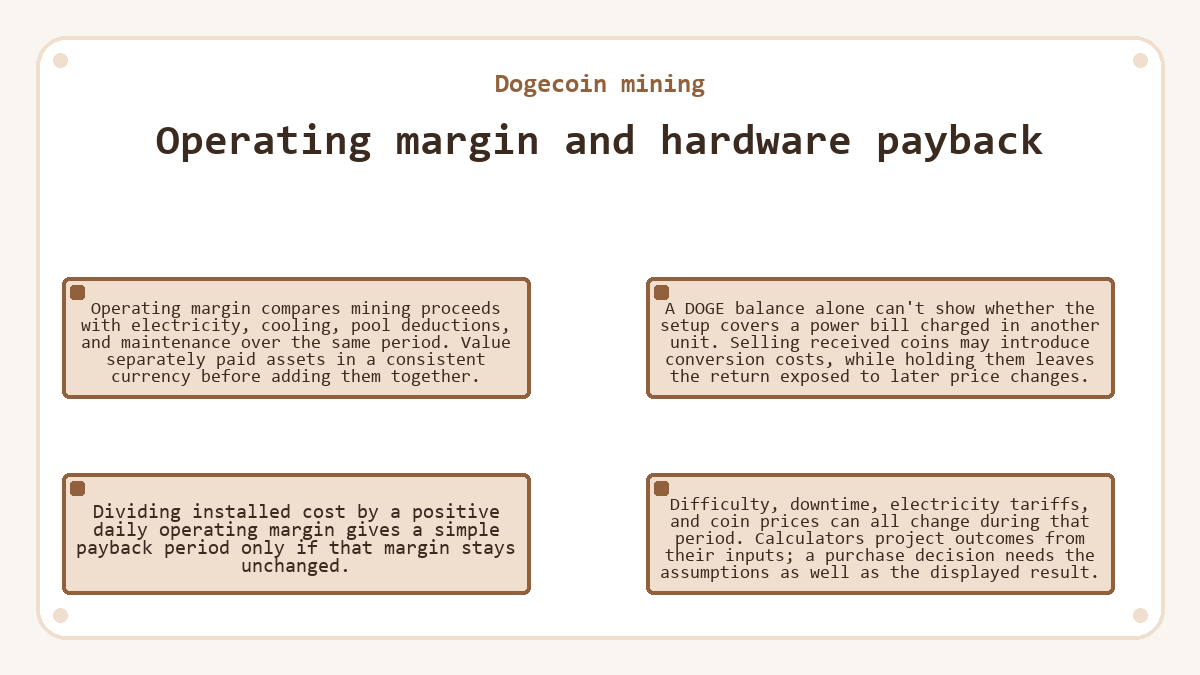
Operating margin compares mining proceeds with electricity, cooling, pool deductions, and maintenance over the same period. Value separately paid assets in a consistent currency before adding them together. A DOGE balance alone can't show whether the setup covers a power bill charged in another unit. Selling received coins may introduce conversion costs, while holding them leaves the return exposed to later price changes.
Dividing installed cost by a positive daily operating margin gives a simple payback period only if that margin stays unchanged. Difficulty, downtime, electricity tariffs, and coin prices can all change during that period. Calculators project outcomes from their inputs; a purchase decision needs the assumptions as well as the displayed result.
Maintenance records and cost revisions
Ongoing records should connect accepted pool work with meter readings, equipment uptime, and actual payments over matching periods. Rejected or stale shares can reduce credited work while the hardware still consumes electricity. Hardware errors, connection problems, and unsuitable operating settings deserve investigation when output changes. Keep the management interface restricted to the intended local network, and use the manufacturer's firmware procedures. Record repairs and cooling changes so they enter later cost comparisons. Accepted work per kilowatt-hour helps reveal whether the setup's electrical consumption is producing usable mining work.
Things people ask about Dogecoin mining
Why does a pool's hashrate estimate fluctuate when the ASIC's display looks steady?
A pool estimates hashrate from submitted shares, so its displayed rate can fluctuate around a steady machine output. Random share arrival and the averaging window affect that estimate. Persistent differences deserve attention, especially alongside hardware errors or rejected work. Compare records over matching periods rather than treating a single snapshot as an exact measurement.
Will raising share difficulty increase my DOGE earnings?
In a pool that credits shares by their difficulty, raising share difficulty doesn't increase expected earnings at unchanged hashrate. It produces fewer shares, each representing more work. Share difficulty controls how the pool measures contributions; Dogecoin's network difficulty determines the work needed for a qualifying block proof.
Are newly mined Dogecoin block rewards spendable immediately?
A newly mined Dogecoin block reward can't be spent immediately. On mainnet, the spending block must be at least 240 blocks higher than the block creating that reward. This restriction applies to coinbase outputs. An ordinary pool payout doesn't inherit that maturity gap, although the pool has its own payment rules.
Which electricity-bill charges can a flat-rate mining calculator miss?
A calculator using only a flat kWh rate can miss demand charges, tariff tiers, and changes between peak and off-peak periods. Some contracts also separate energy and delivery charges. Additional fixed charges matter if the mining installation creates them. The applicable contract determines which costs rise when the miner runs.
Can the management computer shut down while a standalone ASIC keeps mining?
A standalone ASIC can continue mining without the computer used to configure its pool connection. The hashing runs on the ASIC, while the computer provides setup or monitoring access. This assumes the miner has its required network connection and doesn't depend on that computer for a mining proxy or another essential service.
What costs remain when I rent Scrypt hashpower instead of buying an ASIC?
Renting Scrypt hashpower replaces hardware ownership with a payment for mining capacity under the provider's terms. Mining proceeds must still cover the rental charge, applicable service fees, and pool deductions. The operator supplies the physical equipment. Compare compatible Scrypt work and contract delivery terms; renting doesn't establish a profitable return.